Category: Music Education

Posts about music pedagogy, curriculum development, teaching strategies, and educational research.

  • Rhythm and Groove: An Interdisciplinary Literature Review

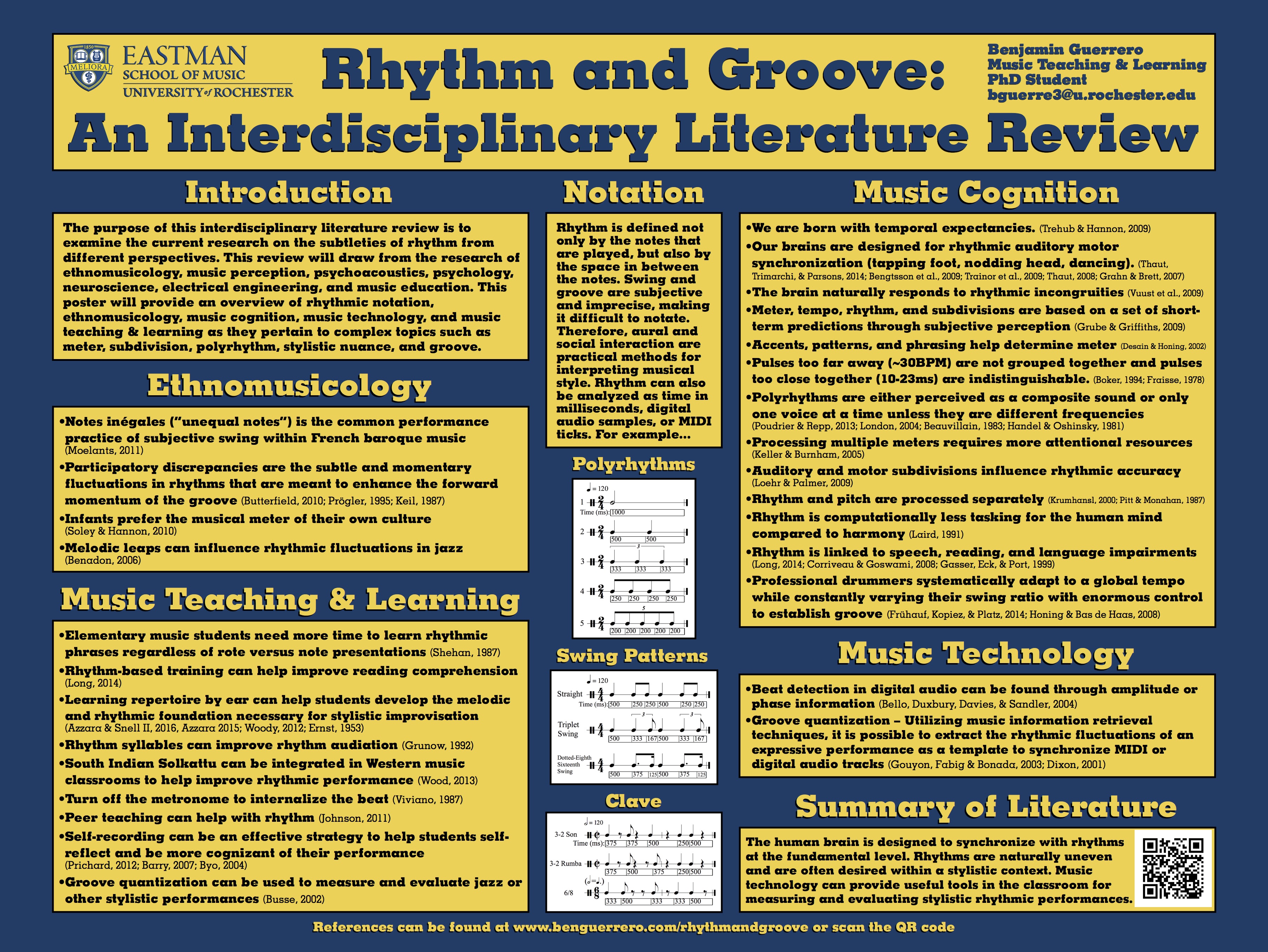
    Rhythm and Groove: An Interdisciplinary Literature Review

    Rhythm and Groove Research Poster

    Abstract

    The purpose of this interdisciplinary literature review is to examine the current research on the subtleties of rhythm from different perspectives. This review will draw from the research of ethnomusicology, music perception, psychoacoustics, psychology, neuroscience, electrical engineering, and music education. This paper will provide an overview of rhythmic notation, ethnomusicology, music cognition, music technology, and music teaching & learning as they pertain to complex topics such as meter, subdivision, polyrhythm, stylistic nuance, and groove.

    Rhythm and Notation

    Music notation is not meant to be an exact dictation of rhythm, but rather an approximation or interpretation of what one hears or wants another musician to perform. Since humans are not machines, it is impossible to play every note perfectly even, so human performances have some slight variation in temporal accuracy. Human-performed rhythms have natural fluctuations and do not always align with a metronome, particularly the inner beats. Even though rigorous practice is required to achieve near-perfect timing and rhythm, some music is expected to be played uneven and imperfect. Musical interpretation involves accents, dynamics, and purposeful tempo fluctuations that are often not written down. Musicians in a large ensemble are also required to adapt their time to that of the conductor’s baton.

    Rhythm Perception and Cognition

    Temporal expectancies occur when one’s brain decomposes a pattern, however complex, and looks for the same or similar pattern in the near future (Desain, 1992). With these expectations, we can decipher rhythm, tempo, and meter. Our brains do this automatically to the extent where we try and create patterns where none may exist, such as looking at random numbers or abstract art (Potter, Fenwick, Abecasis, & Brochard, 2008).

    Rhythm is important because our brains are hardwired to respond and synchronize with rhythmic patterns (Thaut et al. 2009). Our brains’ motor control functions naturally respond to temporal structures, especially when the listener consciously monitors a rhythm. This explains why humans naturally tap their foot or finger, nod their head, or sway back and forth when listening to music.

    Our brains have trouble separating all the layers that we hear from complex rhythms and meters. We have the ability to focus on one sound or rhythmic sequence at a time and ignore all other sounds by treating them like "noise." This process, called selective masking, is similar to when one can block out the sound of an air conditioner whirring in the background and focus on only the person speaking in the room. Another way we decipher complex sounds is by creating a composite pattern that combines all of the layers that are similar (Poudrier & Repp, 2013).

    Swing and Stylistic Nuance

    Music is filled with natural rhythmic imperfections that are often desirable within a style. A jazz swing feel can change depending on tempo, style, and performer. A standard jazz swing pattern is notated as a dotted-eighth sixteenth, a triplet, or as eighth-notes, when in practice, it is constantly fluctuating and lies somewhere in between those rhythms. In 16th Century French Baroque music, this swing feel is known as notes inégales.

    Music Technology and MIDI

    Music Instrument Digital Interface (MIDI) data does not contain or produce any sound, but is rather a roadmap of when, where, and how notes from a synthesizer or sampler should be played. There have been many advancements made in varying the samples used including round robin sampling, articulations, ambience, instrument noises like key clicks and buzzing sounds, and performance analysis to account for pull-offs or alternate strings. Quantization is when notes, either MIDI or digital audio, are snapped to a metronomic grid with standard subdivisions. Groove quantization occurs when those notes are moved to a template that differs from the metronome. The templates can be made from a human performance or by manually moving each subdivision within a measure. This allows MIDI data to be played behind the beat or ahead of the beat on purpose to imitate the temporal qualities of a human performance.

    Implications for Music Education

    It is possible that the advancements made programming a computer how to adjust time between the beats can influence how music educators teach rhythmic accuracy. Subdivision is discussed regularly in classrooms, but not necessarily how to control it and apply that subtleness to musical performance, especially in different styles of music. The better we can understand our brain and how it processes and perceives rhythm, the better software we can program in the future that can then assist us in the future of music creation and education.

    References

    Abramson, R. M. (1980). Dalcroze-based improvisation. Music Educators Journal, 66(2), 62-68.

    Anderson, W. T. (2011). The dalcroze approach to music education: Theory and applications. General Music Today, 26(1), 27-33.

    Benadon, F. (2006). Slicing the beat: Jazz eighth-notes as expressive microrhythm. Ethnomusicology, 50(1), 73-98.

    Bengtsson, S. L., Ullén, F., Ehrsson, H. H., Hashimo, T., Kito, T., Naito, E., . . . Sadato, N. (2009). Listening to rhythms activates motor and premotor cortices. Cortex, 2009(45), 62-71.

    Busse, W. G. (2002). Toward objective measurement and evaluation of jazz piano performance via midi-based groove quantize templates. Music Perception: An Interdisciplinary Journal, 19(3), 443-461.

    Butterfield, M. (2010). Participatory discrepancies and the perception of beats in jazz. Music Perception: An Interdisciplinary Journal, 27(3), 157-176.

    Desain, P. (1992). A (de)composable theory of rhythm perception. Music Perception: An Interdisciplinary Journal, 9(4), 439-454.

    Gordon, E. E. (2012). Learning sequences in music: A contemporary music learning theory. Chicago, IL: GIA Publications.

    Grahn, J. A., & Brett, M. (2007). Rhythm and beat perception in motor areas of the brain. Journal of Cognitive Neuroscience, 19(5), 893-906.

    Honing, H., & Bas de Haas, W. (2008). Swing once more: Relating timing and tempo in expert jazz drumming. Music Perception: An Interdisciplinary Journal, 25(5), 471-476.

    Keil, C. (1987). Participatory discrepancies and the power of music. Cultural Anthropology, 2(3), 275-283.

    Keil, C. (1995). The theory of participatory discrepancies: A progress report. Ethnomusicology, 39(1), 1-19.

    London, J. (2012). Hearing in time: Psychological aspects of musical meter (2nd ed.). Oxford, UK: Oxford University Press.

    Poudrier, È., & Repp, B. H. (2013). Can musicians track two different beats simultaneously? Music Perception, 30(4), 369-390.

    Potter, D. D., Fenwick, M., Abecasis, D., & Brochard, R. (2009). Perceiving rhythm where non exists: Event-related potential (erp) correlates of subjective accenting. Cortex, 45, 103-109.

    Prögler, J. A. (1995). Searching for swing: Participatory discrepancies in the jazz rhythm section. Ethnomusicology, 39(1), 21-54.

    Thaut, M. H., Stephan, K. M., Wunderlich, G., Schicks, W., Tellman, L., Herzog, H., . . . Hömberg, V. (2009). Distinct cortico-cerebellar activations in rhythmic auditory motor synchronization. Cortex, 45(2009), 44-53.

    Zagorski-Thomas, S. (2007). The study of groove. Ethnomusicology Forum, 16(2), 327-335.

  • Dancers’ Auditory Perception of Microtiming Deviations in Drum Grooves

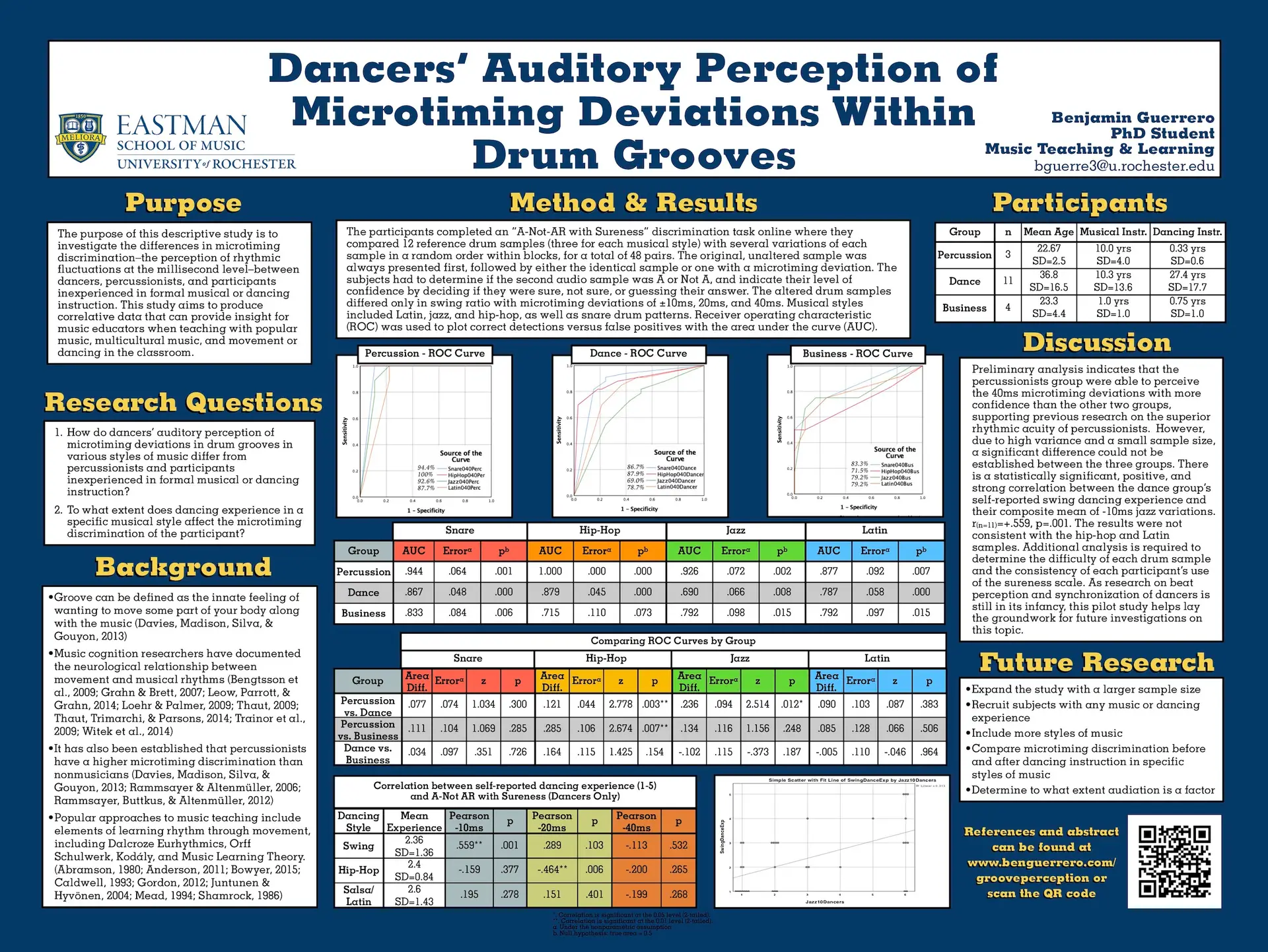
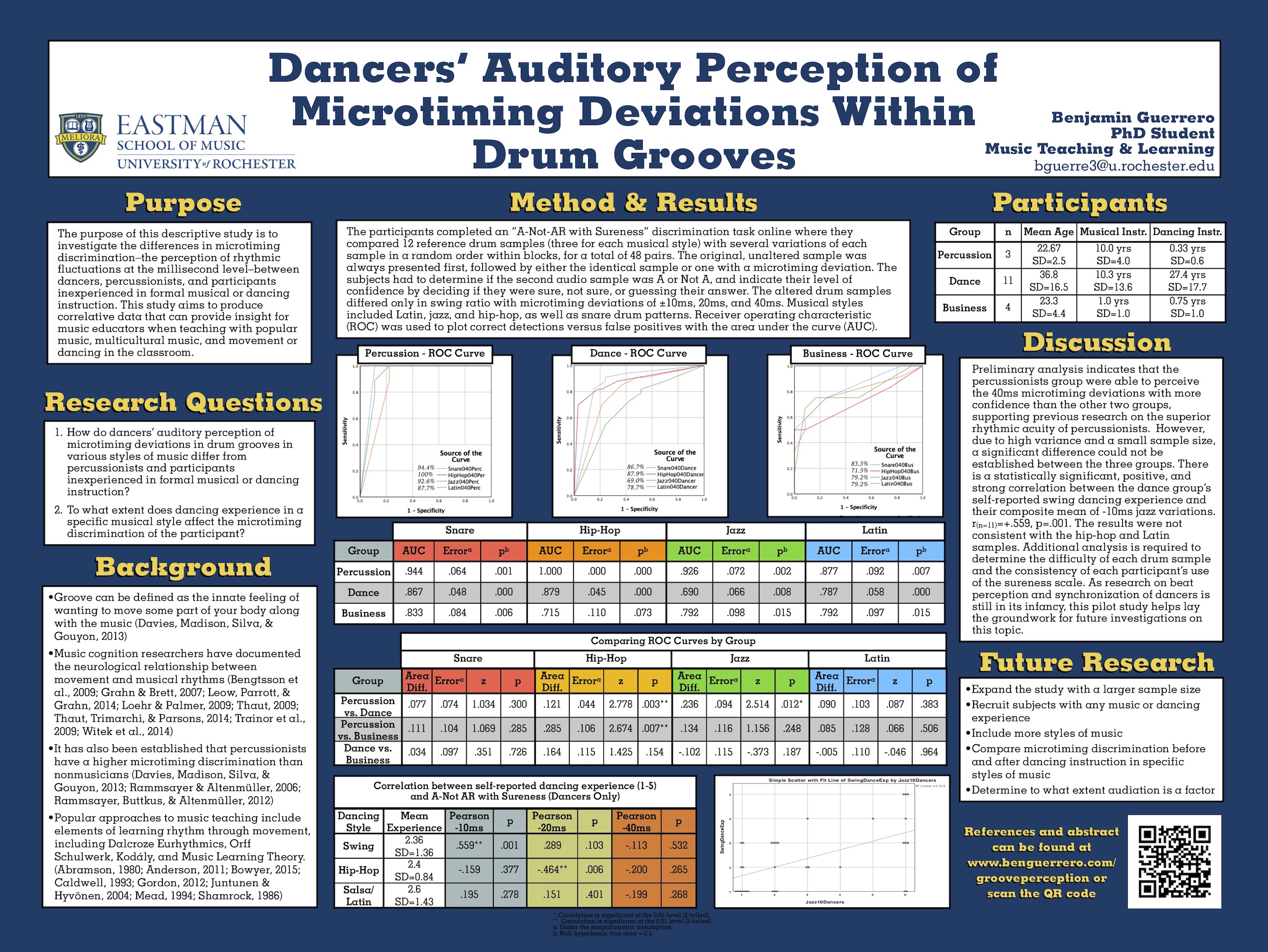
    Dancers’ Auditory Perception of Microtiming Deviations in Drum Grooves

    Groove Perception Research Poster

    Abstract

    The purpose of this descriptive study is to investigate the differences in microtiming discrimination – perception of rhythmic fluctuations at the millisecond level – between dancers, percussionists, and business students. Many popular musical genres have established grooves or feels, and experienced dancers express those grooves through movement. This study aims to produce correlative data that can provide insight for music educators when teaching music of different styles in their classroom. This study may help provide evidence supporting the use of popular music, multicultural music, and movement or dancing in the classroom so that students receive a well-rounded music education. I hypothesized that the discrimination accuracy of the dancers would be in between that of the percussionists and the business students. A sub-hypothesis included that experienced dancers will be more sensitive to microtiming deviations within their preferred musical style compared to inexperienced participants.

    Research Questions

    1. How do dancers’ auditory perception of microtiming deviations in drum grooves in various styles of music differ from percussionists and business students?
    2. To what extent does dancing experience in a specific musical style affect the temporal resolution of the participant?

    Background

    Groove is defined as the innate feeling of wanting to move some part of your body along with the music (Davies, Madison, Silva, & Gouyon, 2013). Music cognition researchers have documented the neurological relationship between movement and musical rhythms (Bengtsson et al., 2009; Grahn & Brett, 2007; Leow, Parrott, & Grahn, 2014; Loehr & Palmer, 2009; Thaut, 2009; Thaut, Trimarchi, & Parsons, 2014; Trainor et al., 2009; Witek et al., 2014). Researchers have shown that percussionists have a higher rhythmic sensitivity than nonmusicians (Davies, Madison, Silva, & Gouyon, 2013; Rammsayer & Altenmüller, 2006; Rammsayer, Buttkus, & Altenmüller, 2012). However, research on the audiomotor entrainment of dancers is still in its infancy. Typically, dancers may or may not produce movements that synchronize with the overall pulse of the music (Kotz, Ravignani, & Fitch, 2018). It is the researcher’s interest to understand the rhythmic perception of dancers in order to make connections between movement, music cognition, and music education.

    The National Association for Music Education (2014) have rhythmic components for all grade levels, and by the 8th grade, it recommends that music students be able to sight-read notation and understand the cultural and historical context of the music to inform with performance. Many of the popular approaches to music teaching include elements of learning rhythm through movement. Dalcroze Eurythmics uses body motion and rhythmic solfege to develop a student’s inner ear, to internalize rhythmic expression, and to develop a foundation for improvisation (Abramson, 1980; Anderson, 2011; Caldwell, 1993; Juntunen & Hyvönen, 2004; Mead, 1994). Orff Schulwerk can help develop students’ understanding of rhythm through group activities using rhythmical body movements, such as clapping or stamping (Shamrock, 1986). The Kodály method infuses games, dances, and play to represent musical lines, in addition to using body percussion (Bowyer, 2015). Music learning theory stresses the importance of using movement to develop rhythmic audiation (Gordon, 2012). Contemporary music education researchers can use cognitive and neurological music research to inform their instruction (Flohr, 2010).

    Methodology

    Participants

    In order to find participants with experience moving to specific musical styles, volunteers from various dance classes at a major university were recruited to participate in the study. A group of percussionists was recruited from the music school to help establish the upper bound for the auditory perception test created for this experiment. A group of business students served as a control group that would ideally have less experience in music or dance instruction.

    Materials

    The stimuli consisted of 48 four-measure drum samples: 12 unaltered drum samples, three samples in four different musical styles, plus three alterations of each drum sample. The altered drum samples differed only in the 16th note swing ratio with microtiming deviations of plus or minus 10ms, 20ms, and 40ms. Musical styles included Latin, jazz, and hip-hop, as well as snare drum patterns.

    To create the altered drum samples, the researcher spliced stylized drum loops from either Logic Pro X or Loopmasters.com at each 16th note transient. All of the drum samples were time-shifted to 130BPM so that the 40ms deviations were sufficiently noticeable across the different musical styles. The snare drum patterns were recorded live, quantized to the metronomic grid, and then edited for the variations. Then, using Logic Pro X, the second and fourth 16th note of each beat was moved plus or minus 10ms, 20ms, or 40ms, depending on whether the sample already contained swung or straight rhythms. The researcher did not edit the 8th note swing variation within each stylized groove. In other words, only the upbeat 16th notes of each beat moved, adding swing to straight samples and removing swing to already swung samples; the downbeats and upbeats remained the same. The audio edit points at each transient were crossfaded manually to remove any digital artifacts. A subtle 80ms reverberation sound effect was added to each sample to help conceal the edit points.

    Procedure

    The subjects participated in an A-Not-AR with Sureness discrimination task with a familiarization process in order to reduce response bias when indicating the confidence in their answers (van Hout, 2014). The subjects compared the 12 unaltered drum samples with the three microtiming alterations of each sample in a random order within blocks based on different musical styles. For each sample pair, the original, unaltered sample was always presented first as a reminder, followed by either the identical sample or one with a microtiming deviation.

    Subjects sat at individual computers and listened to stimuli via headphones. They registered their responses through an online program designed on www.surveygizmo.com. Subjects had to determine if the second audio sample was "A" or "Not A" and indicate their level of confidence by deciding if they were sure, not sure, or guessing their answer for a total of 6 ordinal variables. The subjects also answered background questions about their music listening preferences, musical instruction and performance experience, and dancing instruction and performance experience. As an incentive, the participants were able to enter in a drawing for a gift card. The overall procedure took approximately 25 minutes.

    Discussion

    The analysis indicates that the percussion group was able to perceive the 40ms microtiming deviations with more confidence than the other two groups, supporting previous research on the superior rhythmic acuity of percussionists (Davies, Madison, Silva, & Gouyon, 2013). However, due to high variance and small sample size, a significant difference could not be established between the performance of the dancers and the other two groups. There is a statistically significant, positive, and moderate correlation between the dance group’s self-reported swing dancing experience and their composite mean of -10ms jazz variations. r(n=11) = .559, p = .001. It makes sense that the correlation weakens as the alterations become more obvious with the 20ms and 40ms microtiming deviations. However, the results were not consistent with the hip-hop and Latin samples.

    Additional analysis is required to determine the difficulty of each drum sample. The snare drum and hip-hop samples may have been easier to perceive for some groups because of the clear separated attacks of the rhythms. The alterations in the jazz samples may have been difficult to perceive due to the constant ringing of the ride cymbal and that the fact that the swing feel was being subtracted rather than added. The Latin drum samples may have been difficult due to rhythmic density added from the congas and a shaker on top of the drum set. Future studies may want to compare only single instruments in different styles performing linear rhythm patterns for a more accurate comparison.

    Tempo may also be a factor in the performance of the groups and the quality of the samples as 130BPM may not be the most ecologically valid tempo within each style and pattern. Future studies may want to test the effect tempo plays on the perception of microtiming deviations.

    As research on beat perception and synchronization of dancers is still in its infancy, this pilot study helps lay the groundwork for future investigations on this topic. Auditory rhythmic perception of dancers is a complex topic since they may or may not produce movements that synchronize with the overall pulse of the music (Kotz, Ravignani, & Fitch, 2018). Similar studies may be expanded with a larger sample size and use different discrimination tasks. Future studies can add additional groups for comparison, such as "musician, non-percussionist" or "dancers with musical instruction experience," as well as more styles of music that correspond with appropriate dancing styles. An experimental study can be designed to compare microtiming discrimination before and after dancing instruction in specific styles. Further research will be required to understand the differences in the cognitive decision strategy used by percussionists versus less rhythmically experienced groups, as well as the effect that audiation has on discrimination ability. Overall, this topic is ripe for exploration in the music perception and cognition realm and may produce data that is relevant to music teaching and learning.

    References

    Abramson, R. M. (1980). Dalcroze-based improvisation. Music Educators Journal, 66(2), 62-68.

    Anderson, W. T. (2011). The dalcroze approach to music education: Theory and applications. General Music Today, 26(1), 27-33.

    Bengtsson, S. L., Ullén, F., Ehrsson, H. H., Hashimo, T., Kito, T., Naito, E., . . . Sadato, N. (2009). Listening to rhythms activates motor and premotor cortices. Cortex, 2009(45), 62-71.

    Bowyer, J. (2015). More than solfége and hand signs: Philosophy, tools and lesson planning in the authentic kodály classroom. Music Educators Journal, 102(2), 69-76.

    Caldwell, T. (1993). A dalcroze perspective on skills for learning. Music Educators Journal, 79(7), 27-29.

    Davies, M., Madison, G., Silva, P., & Gouyon, F. (2013). The effect of microtiming deviations on the perception of groove in short rhythms. Music Perception: An Interdisciplinary Journal, 30(5), 497-510.

    Flohr, J. W. (2010). Best practices for young children’s music education: Guidance from brain research. General Music Today, 23(2), 13-19.

    Gordon, E. E. (2012). Learning sequences in music: A contemporary music learning theory. Chicago, IL: GIA Publications.

    Grahn, J. A., & Brett, M. (2007). Rhythm and beat perception in motor areas of the brain. Journal of Cognitive Neuroscience, 19(5), 893-906.

    Juntunen, M., & Hyvönen, L. (2004). Embodiment in musical knowing: How body movement facilitates learning within Dalcroze Eurhythmics. British Journal of Music Education, 21(2), 199-214.

    Kotz, S. A., Ravignani, A., & Fitch, W. T. (2018) The evolution of rhythm processing. Trends in Cognitive Sciences, 22(10), 896-910.

    Leow, L., Parrott, T., & Grahn, J. A. (2014). Individual differences in beat perception affect gait responses to low- and high-groove music. Frontiers in Human Neuroscience, 8(811), 1-12.

    Loehr, J. D., & Palmer, C. (2009). Subdividing the beat: Auditory and motor contributions to synchronization. Music Perception: An Interdisciplinary Journal, 26(5), 415-425.

    Mead, V. (1994). More than mere movement: Dalcroze eurhythmics. Music Educators Journal, 82(4), 38-41.

    National Association for Music Education. (2014). 2014 Music Standards (PK-8 General Music). Retrieved from https://nafme.org/wp-content/files/2014/11/2014-Music-Standards-PK-8-Strand.pdf.

    Rammsayer, T. H., & Altenmüller, E. (2006). Temporal information processing in musicians and nonmusicians. Music Perception: An Interdisciplinary Journal, 24(1), 37-48.

    Rammsayer, T. H., Buttkus, F., & Altenmüller, E. (2012). Musicians do better than nonmusicians in both auditory and visual timing tasks. Music Perception: An Interdisciplinary Journal, 30(1), 85-96.

    Shamrock, M. (1986). Orff schulwerk: An integrated foundation. Music Educators Journal, 72(6), 51-55.

    Thaut, M. H., Stephan, K. M., Wunderlich, G., Schicks, W., Tellman, L., Herzog, H., . . . Hömberg, V. (2009). Distinct cortico-cerebellar activations in rhythmic auditory motor synchronization. Cortex, 45(2009), 44-53.

    Thaut, M. H., Trimarchi, P. D., & Parsons, L. M. (2014). Human brain basis of musical rhythm perception: Common and distinct neural substrates for meter, tempo, and pattern. Brain Sciences, 4, 428-452.

    Trainor, L. J., Gao, X., Lei, J.-j., Lehtovaara, K., & Harris, L. R. (2009). The primal role of the vestibular system in determining musical rhythm. Cortex, 45, 35-43.

    van Hout, D. D. (2014). Measuring meaningful differences: Sensory testing based decision making in an industrial context; applications of Signal detection theory and Thurstonian modelling (No. EPS-2014-304-MKT). ERIM Ph.D. Series Research in Management. Erasmus Research Institute of Management.

    Witek, M. A. G., Clarke, E. F., Wallentin, M., Kringelbach, M. L., & Vuust, P. (2014). Syncopation, body-movement and pleasure in groove music. PLoS ONE, 9(4), 1-12.

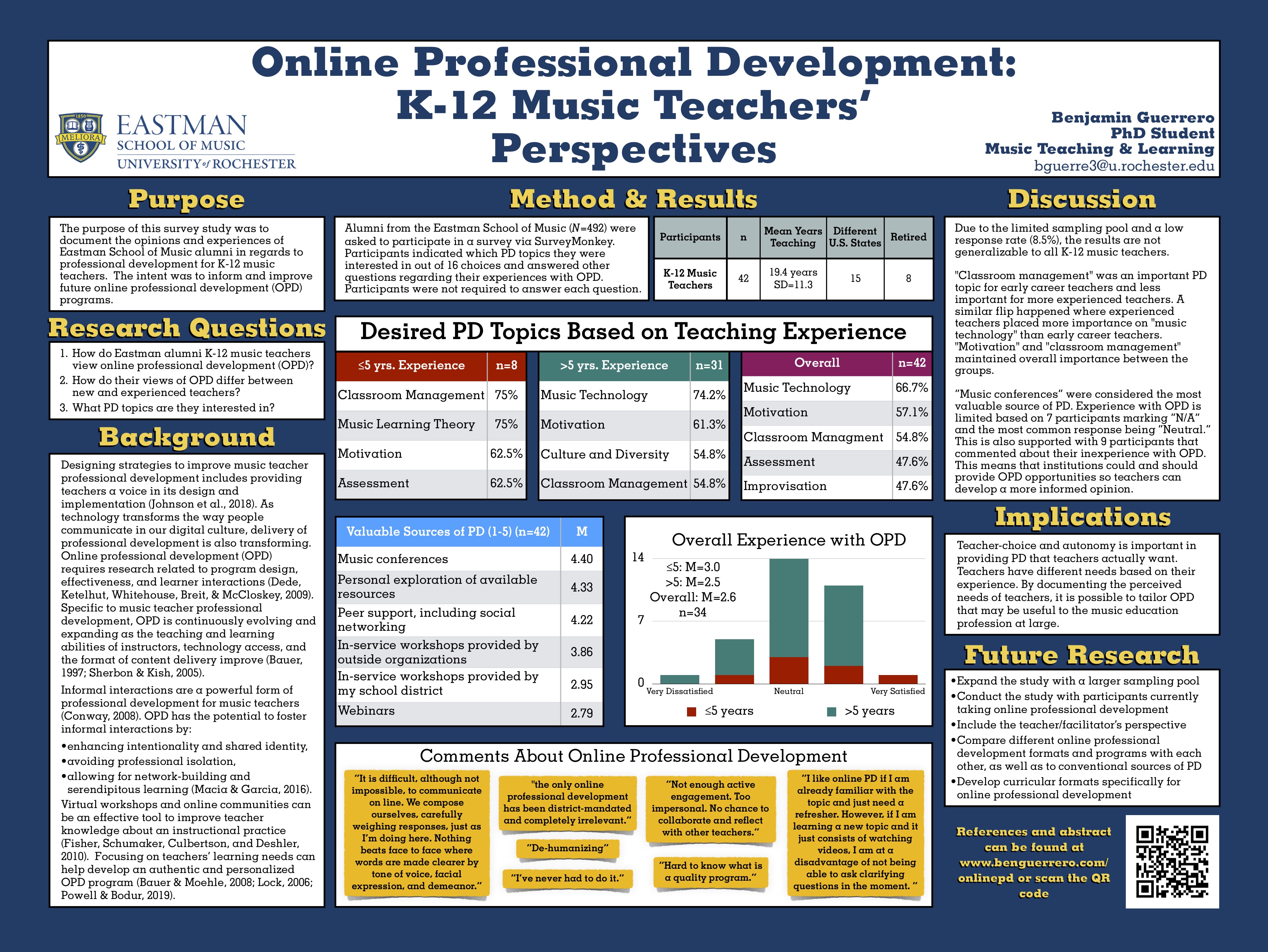
  • Online Professional Development: K-12 Music Teachers’ Perceptions

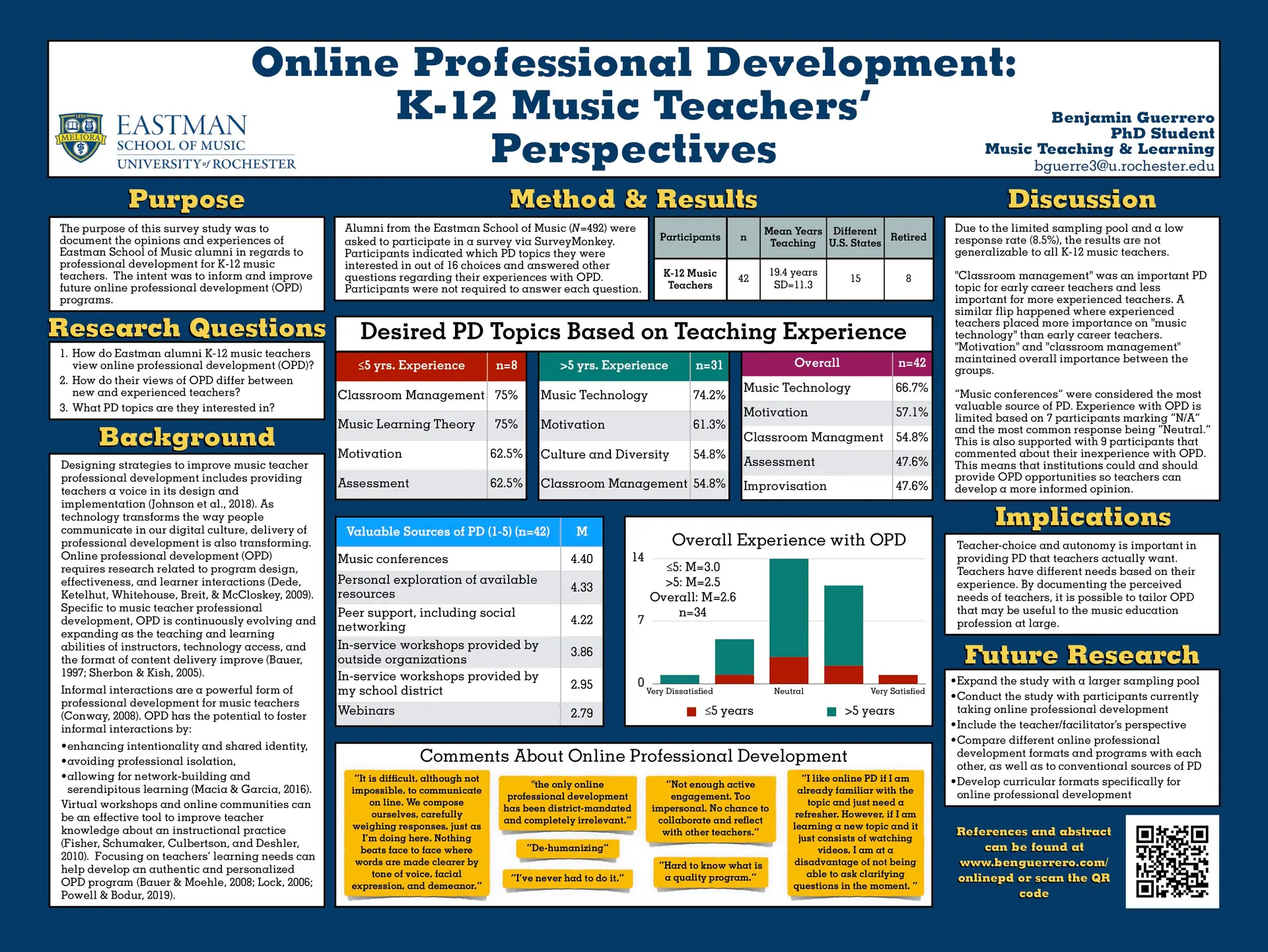
    Online Professional Development: K-12 Music Teachers’ Perceptions

    Online Professional Development Poster

    Abstract

    To inform and improve future music teacher professional development, the purpose of this survey study is to document the opinions and experiences of K-12 music teachers regarding professional development, as well as their perceived professional development needs. Factors under investigation include teaching experience, topics of interest or areas of need, past experience with professional development, and current views of online professional development. Alumni from a major university that are current K-12 music teachers will be asked to participate in this survey. The researchers aim to provide insight on how the needs of experienced music teachers differ from newer teachers, which could help further the development of authentic and personalized online professional development programs.

    Designing strategies to improve music teacher professional development starts with providing teachers a greater voice in its design and implementation. As technology transforms the way people communicate in our digital culture, so can the method of professional development delivery. Online professional development (OPD) is an area in need of research, specifically on program design, effectiveness, and learner interactions (Dede, Ketelhut, Whitehouse, Breit, & McCloskey, 2009). OPD for music teachers is not a new concept, but it is continuously evolving and expanding as the teaching and learning abilities of instructors, technology access, and the format of content delivery improve (Bauer, 1997; Sherbon & Kish, 2005).

    Informal interactions have been found to be a powerful form of professional development for music teachers (Conway, 2008). OPD has the potential to foster social learning by enhancing intentionality and shared identity, avoiding professional isolation, and allowing for network-building and serendipitous learning (Macia & Garcia, 2016). Virtual workshops and online communities can be an effective tool to improve teacher knowledge about an instructional practice (Fisher, Schumaker, Culbertson, and Deshler, 2010). It is important to note that technology itself does not facilitate learning, but it is possible for OPD programs to use it in ways that are consistent with various learning frameworks (Vrasidas & Zembylas, 2004). Focusing on teachers’ learning needs can help develop an authentic and personalized OPD program (Bauer & Moehle, 2008; Lock, 2006; Powell & Bodur, 2019).

    This study is the first step toward developing an OPD program from the ground up. In order to improve the current methods of OPD, which is sometimes merely a pre-recorded video webinar or an online message board, we must first understand what it is that music teachers value in professional development. Then, the next step is to use technology in a meaningful way to connect teachers with the community and facilitators that will be most helpful to them. The results of this process along the way could be beneficial to any music teacher or organization that is interested in improving OPD.

    References

    Bauer, W. I. (1997). Using the internet for professional development. Music Educators Journal, 83(6), 22-27.

    Bauer, W. I. & Moehle, M. (2008). A content analysis of the MENC discussion forums. Bulletin of the Council for Research in Music Education, 175, 71-84.

    Conway, C. M. (2008). Experienced music teacher perceptions of professional development throughout their careers. Bulletin of the Council for Research in Music Education, 176, 7-18.

    Dede, C., Ketelhut, D. J., Whitehouse, P., Breit, L., & McCloskey, E. M. (2009). A research agenda for online teacher professional development. Journal of Teacher Education, 60(1), 8-19.

    Fisher, J., Schumaker, J., Culbertson, J., & Deshler, D. (2010). Effects of a computerized professional development program on teacher and student outcomes. Journal of Teacher Education, 61(4), 302-312.

    Lock, J. V. (2006). A new image: Online communities to facilitate teacher professional development. Journal of Technology and Teacher Education, 14(4), 663-678.

    Macia, M. & Garcia, I. (2016). Informal online communities and networks as a source of teacher professional development: A review. Teaching and Teacher Education, 55, 291-307.

    Powell, C. & Bodur, Y. (2019). Teachers’ perceptions of an online professional development experience: Implications for a design and implementation framework. Teaching and Teacher Education, 77, 19-30.

    Sherbon, J. W. & Kish, D. L. (2005). Distance learning and the music teacher. Music Educators Journal, 92(2), 36-41.

    Vrasidas, C. & Zembylas, M. (2006). Online professional development: Lessons from the field. Education + Training, 46(6/7), 326-334.

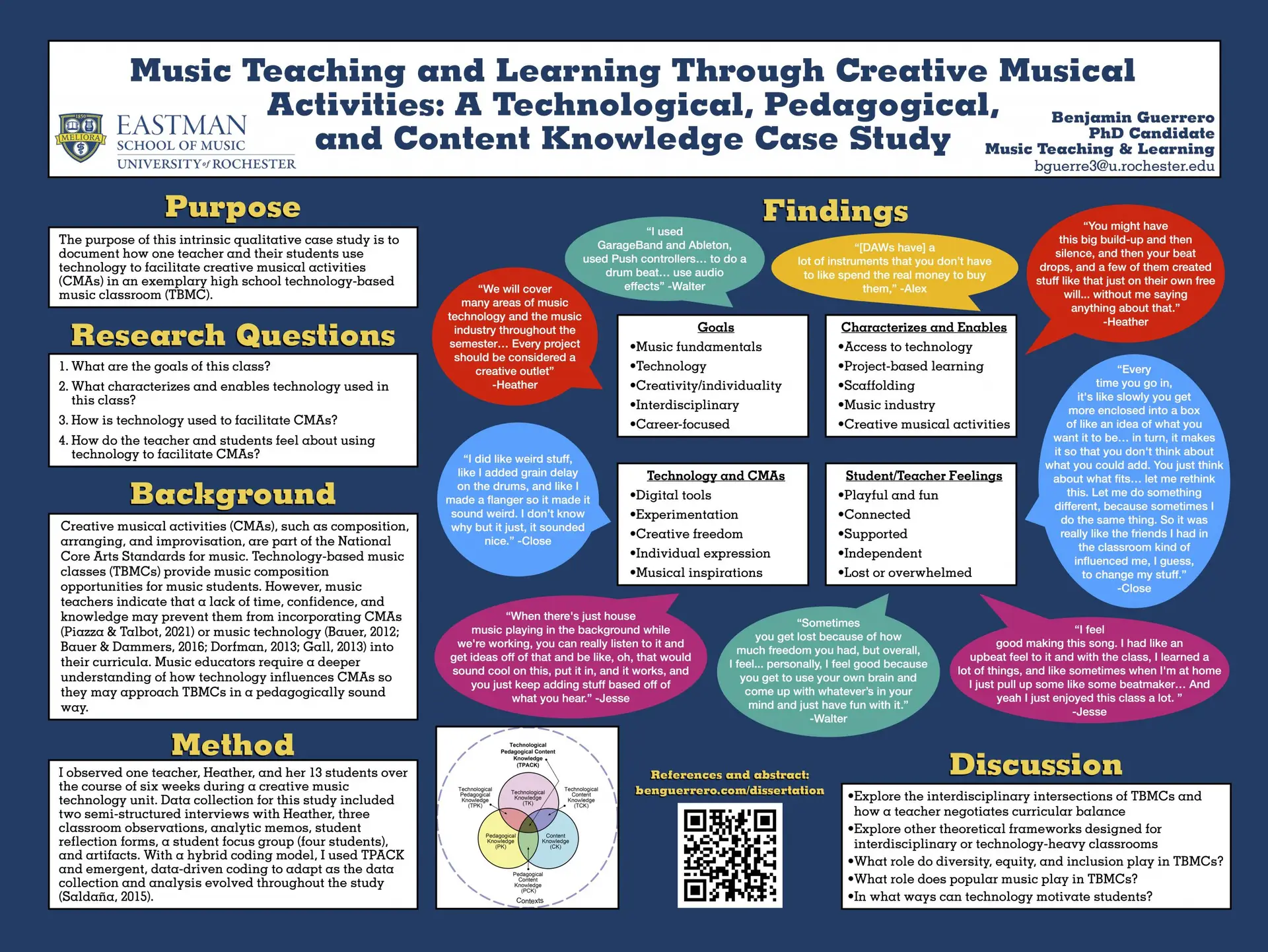
  • Dissertation

    Dissertation

    Dissertation poster presented at SMTE

    Music Teaching and Learning Through Creative Musical Activities: A Technological, Pedagogical, and Content Knowledge Case Study

    Abstract

    Use of technology in music teaching and learning has evolved rapidly in recent years. Creative musical activities (CMAs), such as composition, arranging, and improvisation, are part of the National Core Arts Standards for music. Technology-based music classes (TBMCs) provide music composition opportunities for music students. However, music teachers indicate that a lack of time, confidence, and knowledge may prevent them from incorporating CMAs (Piazza & Talbot, 2021) or music technology (Bauer, 2012; Bauer & Dammers, 2016; Dorfman, 2013; Gall, 2013) into their curricula. Music educators require a deeper understanding of how technology influences CMAs so they may approach TBMCs in a pedagogically sound way. The purpose of this intrinsic case study is to document how one teacher and their students use technology to facilitate CMAs in an exemplary high school TBMC. Research questions guiding this study include: 1) What are the goals of this class? 2) What characterizes and enables technology used in this class? 3) How is technology used to facilitate CMAs? and 4) How do the teacher and students feel about using technology to facilitate CMAs? Data collection included observations, analytic memos, semi-structured interviews, student reflections, student focus group(s), and classroom artifacts based on a 6-week creative music technology unit. After triangulating the data using a hybrid coding model, I present the emerging findings through the lens of the technological, pedagogical, and content knowledge (TPACK) conceptual framework.

    Keywords: music technology, creative musical activities, music education, technology-based music classes, TPACK

    References

    Abril, C. R. (2009). Responding to culture in the instrumental music programme: A teacher’s journey. Music Education Research, 11(1), 77–91. https://doi.org/10.1080/14613800802699176

    Abril, C. R., & Gault, B. M. (2008). The state of music in secondary schools: The principal’s perspective. Journal of Research in Music Education, 56(1), 68–81.

    Archambault, L. (2016). Exploring the use of qualitative methods to examine TPACK. In M. C. Herring, M. J. Koehler, & P. Mishra (Eds.), Handbook of technological pedagogical content knowledge (TPACK) for educators (pp. 65–86). Taylor & Francis Group.

    Azzara, C. D. (2002). Improvisation. In R. Colwell & C. P. Richardson (Eds.), The new handbook of research on music teaching and learning (pp. 171–187). Oxford University Press.

    Azzara, C. D., & Grunow, R. F. (2006). Developing musicianship through improvisation: Book 1. GIA Publications.

    Azzara, C. D., & Snell, A. H. I. (2016). Assessment of improvisation in music. Oxford Handbooks Online. https://doi.org/10.1093/oxfordhb/9780199935321.013.103

    Bakir, N. (2015). An exploration of contemporary realities of technology and teacher education: Lessons learned. Journal of Digital Learning in Teacher Education, 31(3), 117–130.

    Balkin, A. (1990). What is creativity? What is it not? Music Educator’s Journal, 76(9), 29–32. https://doi.org/10.2307/3401074

    Baser, D., Kopcha, T. J., & Ozden, M. Y. (2016). Developing a technological pedagogical content knowledge (TPACK) assessment for preservice teachers learning to teach English as a foreign language. Computer Assisted Language Learning, 29(4), 749–764.

    Bauer, W. I. (2010). Technological pedagogical and content knowledge for music teachers. Society for Information Technology & Teacher Education International Conference 2010, San Diego, CA. https://www.learntechlib.org/p/34001

    Bauer, W. I. (2012). The acquisition of musical technological pedagogical and content knowledge. Journal of Music Teacher Education, 22(2), 51–64.

    Bauer, W. I. (2020). Music learning today: Digital pedagogy for creating, performing, and responding to music (2nd ed.). Oxford Scholarship Online. https://doi.org/10.1093/oso/9780197503706.001.0001

    Bauer, W. I., & Dammers, R. J. (2016). Technology in music teacher education: A national survey. Research Perspectives in Music Education, 18(1), 2–15.

    Bauer, W. I., Hofer, M. J., & Harris, J. (2012). Grounded tech integration using K–12 music learning activity types. Learning & Leading with Technology, 40(3), 30–32.

    Ben-Tal, O., & Salazar, D. (2014). Rethinking the musical ensemble: A model for collaborative learning in higher education music technology. Journal of Music, Technology & Education, 7(3), 279–294.

    Bernhard, H. C. I., & Stringham, D. A. (2016). A national survey of music education majors’ confidence in teaching improvisation. International Journal of Music Education, 34(4), 383–390. https://doi.org/10.1177/0255761415619069

    Biasutti, M. (2015). Pedagogical applications of cognitive research on musical improvisation. Frontiers in Psychology, 6(614). https://doi.org/10.3389/fpsyg.2015.00614

    Bolton, J. (2008). Technologically mediated composition learning: Josh’s story. British Journal for Music Education, 25(1), 41–55. https://doi.org/10.1017/S0265051707007711

    Burton, S. L., & Snell, A. H. I. (2018). Ready, set, improvise: The nuts and bolts of music improvisation. Oxford University Press.

    Campbell, P. S., Myers, D., & Sarah, E. (2016). Transforming music study from its foundations: A manifesto for progressive change in the undergraduate preparation of music majors (Report of the Task Force on the Undergraduate Music Major). College Music Society. https://www.music.org/pdf/pubs/tfumm/TFUMM.pdf

    Chai, C. S., Koh, J. H. L., & Tsai, C.-C. (2013). A review of technological pedagogical content knowledge. Journal of Educational Technology & Society, 16(2), 31–51.

    Chai, C. S., Koh, J. H. L., & Tsai, C.-C. (2016). A review of the quantitative measures of technological pedagogical content knowledge (TPACK). In M. C. Herring, M. J. Koehler, & P. Mishra (Eds.), Handbook of technological pedagogical content knowledge (TPACK) for educators (pp. 97–116).

    Challis, B. (2009). Technology, accessibility and creativity in popular music education. Popular Music, 28(3), 425–431. https://doi.org/10.1017/S0261143009990158

    Clark, W. H., Jr. (1986). Some thoughts on teaching creativity. The Journal of Aesthetic Education, 20(4), 27–31. https://doi.org/10.2307/3332593

    Clauhs, M., Franco, B., & Cremata, R. (2019). Mixing it up: Sound recording and music production in school music programs. Music Educators Journal, 106(1), 55–63.

    Colvin, J. C., & Tomayko, M. C. (2015). Putting TPACK on the radar: A visual quantitative model for tracking growth of essential teacher knowledge. Contemporary Issues in Technology and Teacher Education, 15(1), 68–84.

    Crawford, R. (2009). Secondary school music education: A case study in adapting to ICT resource limitations. Australasian Journal of Educational Technology, 25(4), 471–488.

    Cremata, R. (2010). The use of music technology across the curriculum in music education settings: Case studies of two universities [Doctoral dissertation, Boston University]. Boston, MA.

    Cremata, R., & Powell, B. (2017). Online music collaboration project: Digitally mediated, deterritorialized music education. International Journal of Music Education, 35(2), 302–315. https://doi.org/10.1177/0255761415620225

    Creswell, J. W., & Creswell, J. D. (2018). Research design: Qualitative, quantitative, and mixed methods approaches (5th ed.). Sage Publications.

    Crow, B. (2006). Musical creativity and the new technology. Music Education Research, 8(1), 121–130. https://doi.org/10.1080/14613800600581659

    Csikszentmihalyi, M. (1990). Flow: The psychology of optimal experience. Harper & Row.

    Csikszentmihalyi, M. (2014). The systems model of creativity: The collected works of Mihaly Csikszentmihalyi. Springer. https://doi.org/10.1007/978-94-017-9085-7

    Culp, M. E., & Clauhs, M. (2020). Factors that affect participation in secondary school music: Reducing barriers and increasing access. Music Educators Journal, 106(4), 43–49. https://doi.org/10.1177/0027432120918293

    Dacey, J. (2011). Historical conceptions of creativity. In M. A. Runco & S. R. Pritzker (Eds.), Encyclopedia of creativity (2nd ed., Vol. 1, pp. 608–616). Academic Press.

    Dammers, R. J. (2007). Supporting comprehensive musicianship through laptop computer-based composing problems in a middle school band rehearsal [Dissertation, University of Illinois at Urbana-Champaign]. ProQuest Dissertations & Theses Global.

    Dammers, R. J. (2009). A survey of technology-based music classes in New Jersey high schools. Contributions to Music Education, 36(2), 25–43.

    Dammers, R. J. (2012). Technology-based music classes in high schools in the United States. Bulletin of the Council for Research in Music Education, 194, 73–90.

    Dewey, J. (1938). Experience and education. The Macmillan Company.

    Dobson, E. (2012). An investigation of the processes of interdisciplinary creative collaboration: The case of music technology students working within the performing arts [Doctoral dissertation, Open University]. https://eprints.hud.ac.uk/id/eprint/14689

    Dobson, E. (2019). Talk for collaborative learning in computer-based music production. Journal of Music, Technology & Education, 12(2), 141–164.

    Dobson, E., & Littleton, K. (2016). Digital technologies and the mediation of undergraduate students’ collaborative music compositional practices. Learning, Media and Technology, 41(2), 330–350.

    Dorfman, J. (2008). Technology in Ohio’s school music programs: An exploratory study. Contributions to Music Education, 35, 23–46.

    Dorfman, J. (2013). Theory and practice of technology-based music instruction. Oxford University Press.

    Dorfman, J. (2015). Perceived importance of technology skills and conceptual understandings for pre-service, early- and late-career music teachers. College Music Symposium, 55. https://www.jstor.org/stable/26574400

    Dorfman, J. (2016a). Exploring models of technology integration into music teacher preparation programs. Visions of Research in Music Education, 28.

    Dorfman, J. (2016b). Music teachers’ experiences in one-to-one computing environments. Journal of Research in Music Education, 64(2), 159–178. https://doi.org/10.1177/0022429416649947

    Elpus, K., & Abril, C. R. (2019). Who enrolls in high school music? A national profile of U.S. students, 2009–2013. Journal of Research in Music Education, 67(3), 323–338. https://doi.org/10.1177/0022429419862837

    Emmons, S. E. (1998). Analysis of musical creativity in middle school students through composition using computer-assisted instruction: A multiple case study [Doctoral dissertation, Eastman School of Music]. Rochester, NY.

    Escalante, S. I. (2019). Latinx students and secondary music education in the United States. Update: Applications of Research in Music Education, 37(3), 5–11. https://doi.org/10.1177/8755123318802335

    Fairfield, S. M. (2010). Creative thinking in elementary general music: A survey of teachers’ perceptions and practices [Doctoral dissertation, The University of Iowa]. ProQuest Dissertations and Theses Global.

    Ferreira, G. M. d. S. (2007). Crossing borders: Issues in music technology education. Journal of Music, Technology & Education, 1(1), 23–35. https://doi.org/10.1386/jmte.1.1.23/1

    Freedman, B. (2013). Teaching music through composition: A curriculum using technology. Oxford University Press.

    Freire, P. (1970). Pedagogy of the oppressed. Herder and Herder.

    Gall, M. (2013). Trainee teachers’ perceptions: Factors that constrain the use of music technology in teaching placements. Journal of Music, Technology & Education, 6(1), 5–27. https://doi.org/10.1386/jmte.6.1.5_1

    Grasso, L. A., Parker, M., Graham, T. R., & Riley, J. P. (2019). Improvisation in band and orchestra: A review of literature. In D. A. Stringham & H. C. I. Bernhard (Eds.), Musicianship: Improvising in band and orchestra (pp. 3–21). GIA.

    Guilford, J. P. (1950). Creativity. American Psychologist, 5(9), 444–454.

    Guilford, J. P. (1957). Creative abilities in the arts. Psychological Review, 64(2), 110.

    Haning, M. (2016). Are they ready to teach with technology? An investigation of technology instruction in music teacher education programs. Journal of Music Teacher Education, 25(3), 78–90.

    Harris, J., Grandgenett, N., & Hofer, M. J. (2010). Testing a TPACK-based technology integration assessment instrument. Society for Information Technology & Teacher Education International Conference, San Diego, CA.

    Harris, J., Grandgenett, N., & Hofer, M. J. (2012). Testing an instrument using structured interviews to assess experienced teachers’ TPACK. In Research highlights in technology and teacher education 2012 (pp. 15–22). Society for Information Technology and Teacher Education. https://scholarworks.wm.edu/bookchapters/8

    Heines, J., Greher, G., Ruthmann, S., & Reilly, B. (2011). Two approaches to interdisciplinary computing + music courses. Computer, 44(12), 25–32.

    Heller, G. N. (2011). From the melting pot to cultural pluralism: General music in a technological age, 1892–1992. Journal of Historical Research in Music Education, 33(1), 59–84.

    Henry, W. (1996). Creative processes in children’s musical compositions: A review of the literature. Update: Applications of Research in Music Education, 15(1), 10–15. https://doi.org/10.1177/875512339601500103

    Hess, J. (2015). Decolonizing music education: Moving beyond tokenism. International Journal of Music Education, 33(3), 336–347. https://doi.org/10.1177/0255761415581283

    Hickey, M. (2001). Creativity in the music classroom. Music Educators Journal, 88(1), 17–18. https://doi.org/10.2307/3399771

    Hickey, M. (2012). Music outside the lines: Ideas for composing in K–12 music classrooms. Oxford University Press. https://doi.org/10.1093/acprof:osobl/9780199826773.001.0001

    Hickey, M., & Webster, P. R. (2001). Creative thinking in music. Music Educators Journal, 88(1), 19–23. https://doi.org/10.2307/3399772

    Hofer, M., Grandgenett, N., Harris, J., & Swan, K. (2011). Testing a TPACK-based technology integration observation instrument. Society for Information Technology & Teacher Education International Conference.

    Hofer, M., & Harris, J. (2010). Differentiating TPACK development: Using learning activity types with inservice and preservice teachers. Society for Information Technology & Teacher Education International Conference.

    Holt, M., & Jordan, J. (2008). The school choral program: Philosophy, planning, organizing, and teaching. GIA.

    Hughes, J. (2005). The role of teacher knowledge and learning experiences in forming technology-integrated pedagogy. Journal of Technology and Teacher Education, 13(2), 277–302. https://www.learntechlib.org/primary/p/26105/

    Jaipal-Jamani, K., & Figg, C. (2015). A case study of a TPACK-based approach to teacher professional development: Teaching science with blogs. Contemporary Issues in Technology and Teacher Education, 15(2), 161–200.

    Jassmann, A. E. (2004). The status of music technology in the K–12 curriculum of South Dakota public schools [EdD dissertation, University of South Dakota]. Vermillion, SD.

    Johnson-Laird, P. N. (1987). Reasoning, imagining, and creating. Bulletin of the Council for Research in Music Education, 71–87.

    Jones, C., & King, A. (2009). Peer learning in the music studio. Journal of Music, Technology & Education, 2(1), 55–70.

    Kaschub, M., & Smith, J. (2013). Composing our future: Preparing music educators to teach composition. Oxford University Press. https://doi.org/10.1093/acprof:oso/9780199832286.001.0001

    Kerchner, J. L., & Strand, K. (2016). Musicianship: Composing in choir. GIA.

    Kim, E. (2013). Music technology-mediated teaching and learning approach for music education: A case study from an elementary school in South Korea. International Journal of Music Education, 31(4), 413–427.

    Kimmons, R., Graham, C. R., & West, R. E. (2020). The PICRAT model for technology integration in teacher preparation. Contemporary Issues in Technology and Teacher Education, 20(1), 176–198.

    Kimmons, R., & Hall, C. (2018). How useful are our models? Pre-service and practicing teacher evaluations of technology integration models. TechTrends, 62(1), 29–36.

    Koehler, M. J., & Mishra, P. (2008). Introducing TPCK. In Handbook of technological pedagogical content knowledge (TPCK) for educators (pp. 2–29). Routledge.

    Kokkidou, M. (2013). Critical thinking and school music education: Literature review, research findings, and perspectives. Journal for Learning Through the Arts, 9(1). https://doi.org/10.21977/D9912644

    Liu-Rosenbaum, A., & Creech, A. (2021). The role of technology in mediating collaborative learning in music. In Routledge international handbook of music psychology in education and the community (pp. 433–448). Routledge.

    Martin, M. D. (1999). Band schools of the United States: A historical overview. Journal of Historical Research in Music Education, 21(1), 41–61. https://doi.org/10.1177/153660069902100108

    Martinez, S. L., & Stager, G. S. (2013). Invent to learn: Makers in the classroom. The Education Digest, 79(4), 11.

    Maslow, A. H. (1968). Toward a psychology of being (2nd ed.). Van Nostrand.

    McKnight, K., O’Malley, K., Ruzic, R., Horsley, M. K., Franey, J. J., & Bassett, K. (2016). Teaching in a digital age: How educators use technology to improve student learning. Journal of Research on Technology in Education, 48(3), 194–211. https://doi.org/10.1080/15391523.2016.1175856

    McMullin, C. (2023). Transcription and qualitative methods: Implications for third sector research. VOLUNTAS: International Journal of Voluntary and Nonprofit Organizations, 34(1), 140–153. https://doi.org/10.1007/s11266-021-00400-3

    Mellor, L. (2008). Creativity, originality, identity: Investigating computer-based composition in the secondary school. Music Education Research, 10(4), 451–472. https://doi.org/10.1080/14613800802547680

    Mishra, P., & Koehler, M. J. (2006). Technological pedagogical content knowledge: A framework for teacher knowledge. Teachers College Record, 108(6), 1017–1054.

    Moon, K.-S., & Humphreys, J. T. (2010). The Manhattanville Music Curriculum Program: 1966–1970. Journal of Historical Research in Music Education, 31(2), 75–98.

    Mroziak, J., & Bowman, J. (2016). Music TPACK in higher education. In M. C. Herring, M. J. Koehler, & P. Mishra (Eds.), Handbook of TPACK for educators (pp. 285–296). Taylor & Francis Group.

    NASM. (2016). Philosophy. National Association of Schools of Music. https://nasm.arts-accredit.org/about/philosophy/

    National Center for Education Statistics. (2023). Common core of data: America’s public schools. https://nces.ed.gov/ccd/

    Nielsen, L. D. (2013). Developing musical creativity: Student and teacher perceptions of a high school music technology curriculum. Update: Applications of Research in Music Education, 31(2), 54–62. https://doi.org/10.1177/8755123312473610

    Nilsson, B., & Folkestad, G. (2005). Children’s practice of computer-based composition. Music Education Research, 7(1), 21–37. https://doi.org/10.1080/14613800500042042

    Oehrle, E. (1986). A method of evaluating the extent to which music education texts support creativity: An important aspect of contemporary music education. International Society for Music Education, 13, 169–178.

    Piazza, E. S., & Talbot, B. C. (2021). Creative musical activities in undergraduate music education curricula. Journal of Music Teacher Education, 30(2), 37–50. https://doi.org/10.1177/1057083720948463

    Pitts, A., & Kwami, R. M. (2002). Raising students’ performance in music composition through the use of information and communications technology (ICT): A survey of secondary schools in England. British Journal of Music Education, 19(1), 61–71.

    Postman, N. (1992). Technopoly: The surrender of culture to technology. Vintage.

    Powell, B. (2021). Modern band: A review of literature. Update: Applications of Research in Music Education, 39(3), 39–46.

    Powell, B., & Burstein, S. (2016). Popular music and modern band principles. Routledge.

    Powell, B., & Burstein, S. (2017). Popular music and modern band principles. In G. D. Smith, Z. Moir, M. Brennan, S. Rambarran, & P. Kirkman (Eds.), The Routledge research companion to popular music education (pp. 243–254). Routledge.

    Puentedura, R. R. (2013). SAMR: Moving from enhancement to transformation. http://www.hippasus.com/rrpweblog/archives/000095.html

    Randles, C. (2009). ‘That’s my piece, that’s my signature, and it means more’: Creative identity and the ensemble teacher/arranger. Research Studies in Music Education, 31(1), 52–68. https://doi.org/10.1177/1321103×09103631

    Randles, C., & Stringham, D. (2013). Musicianship: Composing in band and orchestra. GIA.

    Reese, S., & Rimington, J. (2000). Music technology in Illinois public schools. Update: Applications of Research in Music Education, 18(2), 27–32.

    Rudolph, T. E. (1996). Teaching music with technology. GIA Publications.

    Running, D. J. (2008). Creativity research in music education: A review (1980–2005). Update: Applications of Research in Music Education, 27(1), 41–48. https://doi.org/10.1177/8755123308322280

    Ruthmann, S. A. (2006). Negotiating learning and teaching in a music technology lab: Curricular, pedagogical, and ecological issues [Doctoral dissertation, Oakland University]. ProQuest Dissertations & Theses Global.

    Ruthmann, S. A. (2008). Whose agency matters? Negotiation pedagogical and creative intent during composing experiences. Research Studies in Music Education, 30(1), 43–58. https://doi.org/10.1177/1321103×08089889

    Saldaña, J. (2015). The coding manual for qualitative researchers (3rd ed.). SAGE Publications.

    Seddon, F. A., & O’Neill, S. A. (2001). An evaluation study of computer-based compositions by children with and without prior experience of formal instrumental music tuition. Psychology of Music, 29(1), 4–19.

    Seddon, F. A., & O’Neill, S. A. (2003). Creative thinking processes in adolescent computer-based composition: An analysis of strategies adopted and the influence of instrumental music training. Music Education Research, 5(2), 125–137. https://doi.org/10.1080/1461380032000085513

    Shulman, L. S. (1986). Those who understand: Knowledge growth in teaching. Educational Researcher, 15(2), 4–14.

    Siemon, D., Plaumann, R., Regenberg, A., Yuan, Y., Liu, Z., & Robra-Bissantz, S. (2016). Tinkering for creativity: An experiment to utilize Makey Makey invention kit as group priming to enhance collaborative creativity. AMCIS.

    Snell, A. H., II. (2012). Creativity in instrumental music education: A survey of winds and percussion music teachers in New York State [Doctoral dissertation, University of Rochester]. ProQuest Dissertations and Theses Global.

    State Education Agency Directors of Arts Education. (2014a). National core arts standards. http://www.nationalartsstandards.org

    State Education Agency Directors of Arts Education. (2014b). National core arts standards — music technology strand. http://www.nationalartsstandards.org/sites/default/files/Music%20Tech%20Strand%20at%20a%20Glance%204-20-15.pdf

    Stauffer, S. L. (2001). Composing with computers: Meg makes music. Bulletin of the Council for Research in Music Education, 150, 1–20. https://www.jstor.org/stable/40319096

    Stringham, D. A., & Bernhard, H. C. I. (2019). Musicianship: Improvising in band and orchestra. GIA.

    Stringham, D. A., Thornton, L. C., & Shevock, D. J. (2015). Composition and improvisation in instrumental methods courses: Instrumental music teacher educators’ perspectives. Bulletin of the Council for Research in Music Education, 205, 7–25. https://doi.org/10.5406/bulcouresmusedu.205.0007

    Tai, S.-J. D., & Crawford, D. (2014). Conducting classroom observations to understand TPACK: Moving beyond self-reported data. Society for Information Technology & Teacher Education International Conference 2014, Jacksonville, FL. https://www.learntechlib.org/p/131189

    Technological Pedagogical Content Knowledge. (2012). Technological pedagogical content knowledge. tpack.org

    TIM. (2009). Technology integration matrix. https://fcit.usf.edu/matrix/

    Tobias, E. S. (2012). Composing, songwriting, and producing: Informing popular music pedagogy. Research Studies in Music Education, 35(2), 213–237. https://doi.org/10.1177/1321103X13487466

    Tobias, E. S. (2013). Toward convergence: Adapting music education to contemporary society and participatory culture. Music Educators Journal, 99(4), 29–36. https://doi.org/10.1177/0027432113483318

    Tobias, E. S. (2014). Flipping the misogynist script: Gender, agency, hip hop and music education. Action, Criticism & Theory for Music Education, 13(2), 48–83.

    Tobias, E. S., Campbell, M. R., & Greco, P. (2015). Bringing curriculum to life: Enacting project-based learning in music programs. Music Educators Journal, 102(2), 39–47.

    U.S. Department of Education National Center for Education Statistics. (2010). Teachers’ use of educational technology in U.S. public schools: 2009, first look. https://nces.ed.gov/pubs2010/2010040.pdf

    U.S. Department of Education National Center for Education Statistics. (2021). Use of educational technology for instruction in public schools: 2019–20. https://nces.ed.gov/pubs2021/2021017.pdf

    Upitis, R., Abrami, P. C., & Boese, K. (2016). The use of digital tools by independent teachers. International Association for Development of the Information Society (IADIS) International Conference on Mobile Learning, Vilamoura, Algarve, Portugal.

    Viig, T. G. (2015). Composition in music education: A literature review of 10 years of research articles published in music education journals.

    Voogt, J., Fisser, P., Tondeur, J., & van Braak, J. (2016). Using theoretical perspectives in developing an understanding of TPACK. In Handbook of technological pedagogical content knowledge (TPACK) for educators (pp. 33–52). Routledge.

    Vossoughi, S., & Bevan, B. (2014). Making and tinkering: A review of the literature. National Research Council Committee on Out of School Time STEM, 67, 1–55.

    Wallas, G. (1926). The art of thought. Harcourt, Brace.

    Ward, C. J. (2009). Musical exploration using ICT in the middle and secondary school classroom. International Journal of Music Education, 27(2), 154–168. https://doi.org/10.1177/0255761409102323

    Watson, S. (2011). Using technology to unlock musical creativity. Oxford University Press.

    West, C., & Clauhs, M. (2015). Strengthening music programs while avoiding advocacy pitfalls. Arts Education Policy Review, 116(2), 57–62. https://doi.org/10.1080/10632913.2015.1007831

    Williams, D. A. (2017). Music technology pedagogy and curricula. In S. A. Ruthmann & R. Mantie (Eds.), The Oxford handbook of technology and music education (pp. 633–646). Oxford University Press. https://doi.org/10.1093/oxfordhb/9780199372133.013.60

    Williams, D. B. (2012). The non-traditional music student in secondary schools of the United States: Engaging non-participant students in creative music activities through technology. Journal of Music, Technology & Education, 4(2–3), 131–147. https://doi.org/10.1386/jmte.4.2-3.131_1

    Wise, S. (2016). Secondary school teachers’ approaches to teaching composition using digital technology. British Journal of Music Education, 33(3), 283–295. https://doi.org/10.1017/S0265051716000309

    Wolff, C. (2000). Johann Sebastian Bach: The learned musician. W. W. Norton.