Abstract
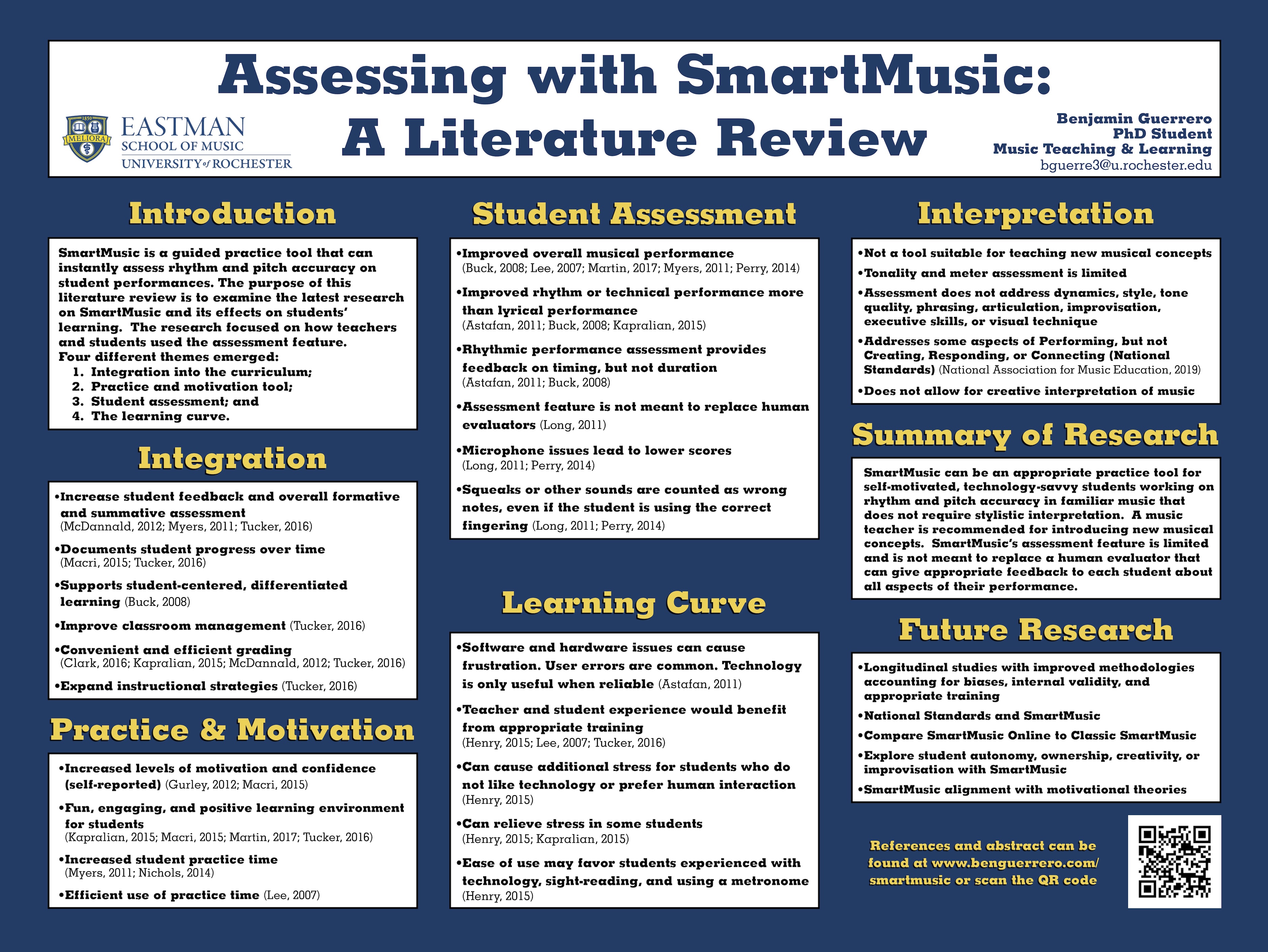
When music educators go to conferences and learn about SmartMusic, they usually hear from representatives of MakeMusic or from other teachers that talk about how they use it in their classroom, but not enough research on SmartMusic’s effectiveness is presented. The purpose of this literature review is to examine the research on SmartMusic’s overall impact in the music classroom. Through the researcher’s analysis, four different themes emerged from the literature: integration in the classroom, SmartMusic as a practice tool, SmartMusic for assessment, and the learning curve. There will also be a critique of the issues and limitations of the current research.
Integration in the Classroom
There is no single method of integrating technology into the classroom. Teachers who have used SmartMusic in the classroom often see it as a way to expand their instructional strategies (Tucker, 2016). It is not meant to replace teachers or traditional instruction, but rather augment the teaching and learning experience. Common obstacles of music assessment are that it can be difficult, expensive, and time-consuming when there are so many students and so little contact hours (Lehman, 2007). Each student has their own profile within SmartMusic allowing the teacher to assign specific method book pages, warm-ups, etudes, concert music, or whatever other music the teacher deems necessary for the student. This allows the teacher to differentiate their teaching for each individual student and adapting their current curriculum so that it is more student-centered (Buck, 2008). Because SmartMusic has the ability to audio record the students as well as provide a preliminary performance assessment, it can make the grading process more convenient and efficient for some teachers (Clark, 2016; Kapralian, 2015; McDannald, 2012; Tucker, 2016).
SmartMusic as a Practice Tool
In terms of how SmartMusic can affect students’ learning, through teacher interviews and student surveys, the research shows that the software can be fun and engaging for students by creating a positive learning environment (Kapralian, 2015; Macri, 2015; Martin, 2017; Tucker, 2016). Through pre- and post-surveys in studies where students were practicing using SmartMusic with the accompaniment feature, students reported in increase in their motivation and confidence when practicing (Gurley, 2012; Macri, 2015). Students often reported that the immediate feedback and assessment from the software encouraged them to practice more, especially the sections they were having difficulty with. This also added a sense of accomplishment when they were able to increase their computer-generated score. Students also enjoyed the ability to have a piano or full orchestra play along with them as they practiced. These features also helped increase the amount of time that students practiced per week (Myers, 2011; Nichols, 2014).
SmartMusic for Assessment
There have been numerous studies that have shown the various ways that the use of SmartMusic can improve music students’ overall performance ability, but more specifically, the students’ rhythmic accuracy if the students already know how to count rhythms and were already familiar with SmartMusic (Astafan, 2011; Buck, 2008; Kapralian, 2015; Lee, 2007; Martin, 2017; Myers, 2011; Perry, 2014). With rhythmic errors, a red note head representing the student’s performance is placed in front of or behind the written note depending on whether the student rushed or dragged, but the students could not self-correct if they did not already know how to count and subdivide rhythms. Melodic and lyrical etude performances did not necessarily improve.
The Learning Curve
As with most technology, there is a number of software and hardware issues that can occur, which can lead to a frustrating user experience. Even though many problems end up being user error, the technology is only useful when it is reliable (Astafan, 2011). Several researchers concluded that both students and teachers would benefit from professional development and training with SmartMusic (Henry, 2015; Lee, 2007; Tucker, 2016).
Future Research
None of the studies had a perfect methodology and it is possible that one does not exist, but it does leave room for improvement. Previous methodologies could be adjusted so that the data is more reliable. This would also improve the accuracy of the data in order to make more conclusive claims about the impact of SmartMusic. Other topics that can be explored with SmartMusic can include ownership, autonomy, creativity, or improvisation. Any claims about motivation or confidence were using student surveys with Likert scales, but none of them discussed whether or not SmartMusic aligns with current motivational theories. With these many avenues of research topics still available to conduct, the timing is ripe for any graduate student, teacher, or researcher to explore what has still yet to be discovered with SmartMusic.
References
Astafan, C. (2011). Smartmusic: Using technology to assess rhythmic ability within instrumental music in the elementary school classroom. Retrieved from Institute of Education Sciences: https://eric.ed.gov/?id=ED518581.
Buck, W.B. (2008). The efficacy of smart music assessment as a teaching and learning tool. (Doctoral dissertation). Retrieved from http://aquila.usm.edu/dissertations/1136.
Clark, A. (2016). Vocal sight-reading achievement using technological tools. (Master’s thesis). Retrieved from http://andreclark.com/wp-content/uploads/Final-Revision-Andre-Clark-2016.04.20.pdf.
Gurley, R. (2012). Student perception of the effectiveness of smart music as a practice and assessment tool on middle school and high school band students.(Master’s thesis). Retrieved from http://hdl.handle.net/2346/45246.
Henry, M. (2015). Vocal sight-reading assessment: Technological advances, student perceptions, and instructional implications. National Association for Music Education, Update: Applications of Research for Music Education, 33(2), 58-64.
Kapralian, B. (2015). The effectiveness of computer enhanced instruction on the rhythmic ability and assessment of music students. (Master’s thesis). Retrieved from https://dspace.carthage.edu/handle/123456789/1108.
Lee, E. (2007). A study of the effect of computer assisted instruction, previous music experience, and time on the performance ability of beginning instrumental music students. (Doctoral dissertation). Retrieved from http://digitalcommons.unl.edu/dissertations/AAI3284028.
Lehman, P. (2007). Getting down to basics. In T. Brophy (Ed.), Assessment in music education: Integrating curriculum, theory, and practice; Proceedings of the 2007 florida symposium on assessment in music education. Chicago, IL: GIA Publishing.
Macri, J. (2015). Computer-assisted self-assessment in high school instrumental music: An exploratory case study.(Doctoral dissertation). Retrieved from ProQuest Dissertations Publishing. (3708842).
Martin, E. (2017). The influence of supplemental instruction on student musicianship: An action research study. (Doctoral dissertation). Retrieved from ProQuest Dissertations Publishing. (10288908).
McDannald, B. (2012). A comparative summary of content and integration of technological resources in six beginning band methods. (Master’s thesis). Retrieved from http://centralspace.ucmo.edu/handle/10768/127.
Myers, D. (2011). A comparison between traditional home instruction practice methods and smartmusic practice technology.(Master’s thesis). Retrieved from ProQuest Dissertations Publishing. (1490895).
National Association for Music Education. (2018). Standards. Retrieved from https://nafme.org/my-classroom/standards/
Nichols, B. (2014). The effect of smartmusic on student practice. (Doctoral dissertation). Retrieved from Digital Commons @ Kennesaw State University, (1).
Perry, P. (2014). The effect of flexible practice computer-assissted instruction and cognitive style on the development of music performance skills of high school instrumental students. (Doctoral dissertation). Retrieved from ProQuest Dissertations Publishing. (3680791).
Tucker, C. F. (2016). A case study of the integration of smartmusic into three middle school band classrooms found in upstate south carolina. (Doctoral dissertation). Retrieved from Digital Commons @ Gardner-Webb University. (170).